
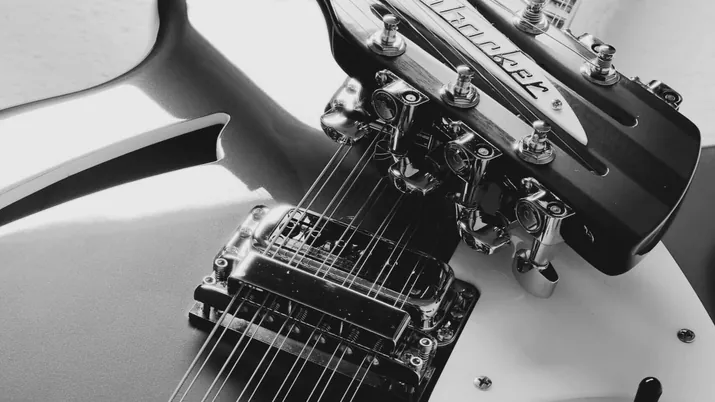
Rickenbacker: Legendary Guitars and Basses Made in Santa Ana, California
Put on "A Hard Day's Night" and listen to that first crashing chord. Then put on "Mr. Tambourine Man" by The Byrds, or anything off the early Rush records with Geddy Lee's bass growling like a muscle car at a stoplight. Different bands, same badge on the headstock.
Rickenbacker has been building electric instruments in Southern California since 1931. Not designed there and shipped in from somewhere else. Built, start to finish, in their own factory in Santa Ana.
The guitar that was named after a pilot
The story starts in 1920s Los Angeles with a steel guitar player named George Beauchamp (pronounced "Beechum," which turns out to matter). He wanted a louder guitar, so he started tinkering with something nobody had cracked yet: a pickup that turned vibrating strings directly into electric current.
He worked at his dining room table and, according to the company's own history, wound the coil using the motor from the family washing machine. A craftsman carved a wooden body for it in a few hours, and the first fully electric guitar was born. With its round body and long neck, everyone called it the "Frying Pan."
To actually manufacture it, Beauchamp teamed up with his friend Adolph Rickenbacker, a Swiss born tool and die man. They put Adolph's name on the instruments for two reasons. His relative was Eddie Rickenbacker, the famous World War I flying ace. And it was a lot easier to say than Beauchamp.
They launched in 1931, right at the bottom of the Great Depression. Good timing, fellas. They made it anyway.
Still made in Santa Ana
Fast forward 95 years and Rickenbacker is still a California company, run by CEO John Hall out of Santa Ana. Their factory tour is worth a read, because this is not an assembly line full of robots.
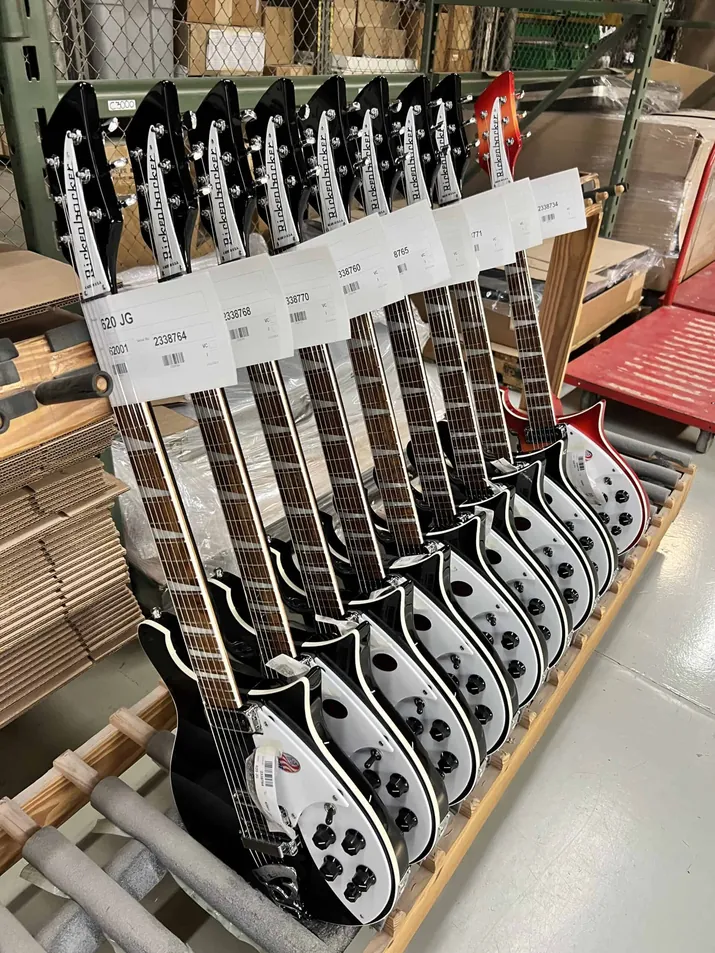
Every instrument starts as Eastern hardrock maple, inspected by hand. Where most guitar necks use two or three pieces of wood, a Rickenbacker neck uses at least four laminations and sometimes as many as eleven, which keeps it from twisting over the years. The 4000 series basses use neck through body construction, so the strings ride on one continuous piece of wood. That's a big part of where all that sustain comes from.
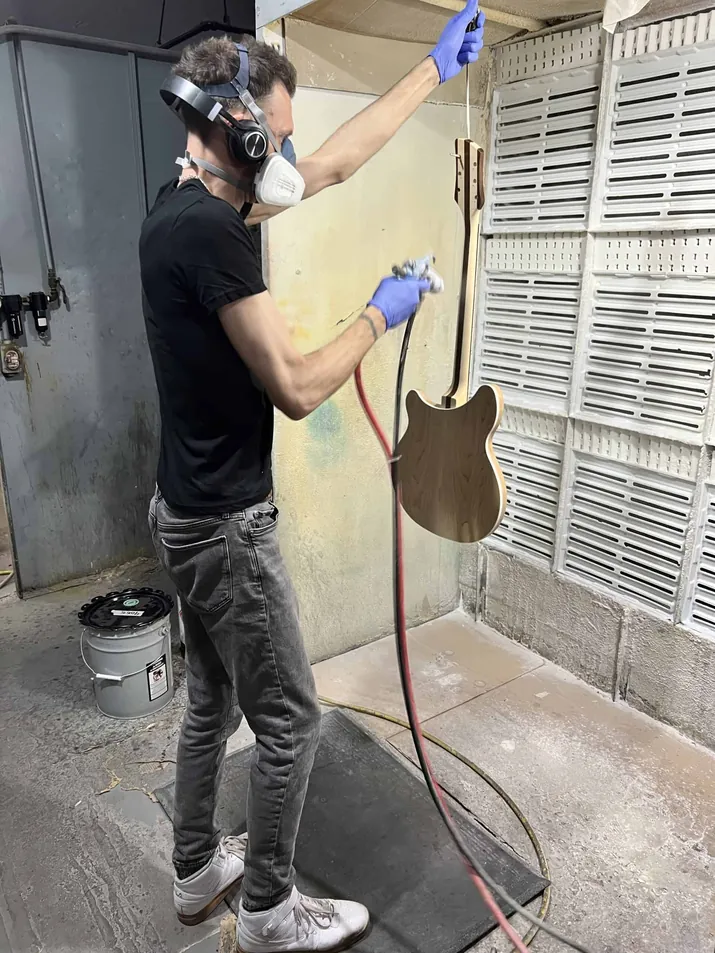
The paint room is where it gets a little nuts. In their words, there are "no paint robots or hydro-static sprayers" in there, just experienced people shading each guitar by hand. Then each one gets more than an hour and fifteen minutes of buffing and waxing. Most companies, they point out, spend about fifteen minutes.
They have made their own parts since 1931, and for the electronics the company says it tries "to source only the finest American-made electronic components," which means Switchcraft jacks and switches and custom CTS potentiometers.
The basses that built a sound
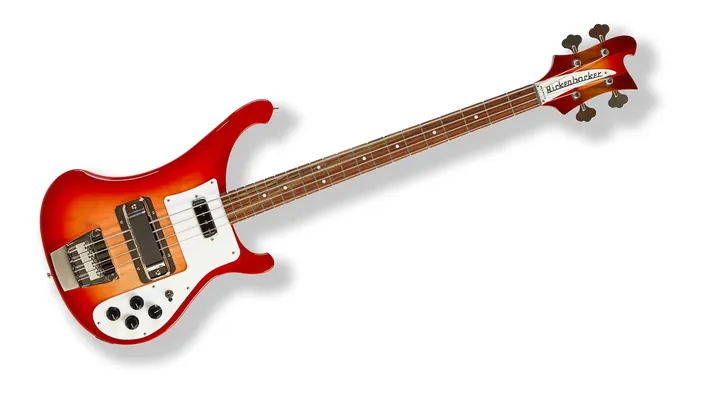
If you play bass, you already know the shape. The 4003 is the classic, with its sweeping maple body, triangle inlays and stereo output. Rickenbacker describes it as "famous for its ringing sustain, treble punch and solid underlying bass," and nobody who has heard one would argue.
Geddy Lee is probably the most famous example. Through the 1970s, his Rickenbacker 4001 was all over the Rush catalog, as much a part of the band as Neil Peart's drums or Alex Lifeson's guitar (we covered the American made PRS guitars Alex played in an earlier article). Chris Squire of Yes built his whole sound on one, and Lemmy cranked his to ear splitting levels in Motörhead.
The 4003S is the stripped down version Paul McCartney and Squire played in 1964, with dot inlays and rounded edges. There's also the 4003W and 4003SW with a walnut body, and the 4005V, a 1965 semi-hollow reissue the company calls "perhaps the most anticipated re-issue" in its history.
Jangle, chime and twelve strings
On the guitar side, the 360/12 might be the most important twelve string electric ever made. George Harrison got one in 1964 and it showed up all over "A Hard Day's Night." Roger McGuinn heard it, grabbed one of his own, and the jangle of The Byrds was born. Tom Petty and Peter Buck of R.E.M. owe a little something to that sound too.
Part of the magic is a quirky detail. On a Rickenbacker twelve string, the regular string comes first and the octave string comes second, the reverse of most other makers. It sounds like a small thing. It isn't.
The rest of the lineup is just as fun:
- The 330 and 330/12, with the slash shaped sound hole and a warm, full voice
- The 360, the deluxe six string with binding and triangle inlays
- The 1993Plus, updated at the request of Pete Townshend, who smashed a few early Rics on stage
- The 350V63 Liverpool, a full scale take on the short 325 that John Lennon made famous
- The 325C64 and 360/12C63 from the C Series, built to match specific historic guitars
- The 620, 660 and 660/12 solid bodies with that "Cresting Wave" outline
- The W Series, which swaps in walnut, including the 330W, 330/12W, 360W and 360/12W
The company that won't pay for a famous name
Here's something you don't see much anymore. Rickenbacker doesn't do artist endorsements. Their FAQ says the company has "a strict policy against endorsing musicians or special projects," because they want everyone to enjoy the instruments "without bias." Geddy, Lemmy, the Beatles. Nobody was paid to play one. They just wanted the sound.
You also can't buy one at the factory. New guitars only come through authorized dealers, and custom orders are on hold because of a big backlog. When demand outruns supply for a guitar made by hand in California, the folks in Santa Ana are doing something right.
Own an older one? The serial number decoder will date it, and the price list archive shows what it cost new. There's even a counterfeit report form, because when you build something this iconic, people try to copy it.
California has given us some great American made gear, from Vandersteen speakers to SKB cases. Add Rickenbacker to that list, a company that started at a dining room table in 1931 and has been building guitars by hand in Southern California ever since.
Just another great reason to buy American!