
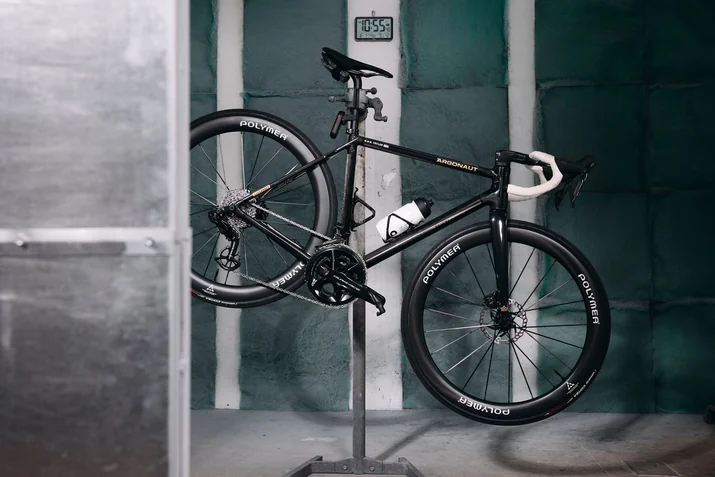
Argonaut Cycles: American Made Custom Carbon Bikes Built in Bend, Oregon
Almost every carbon fiber bicycle in America comes from the same handful of factories in Asia. Not similar factories. The same ones. Brands you think of as rivals are frequently sharing a molding line and arguing over paint.
Argonaut Cycles builds no more than 200 bicycles a year in a shop in Bend, Oregon, and their founder has a line about why that is worth the trouble.
"We never outsource. We know the name of every person who touches our frames."
Steel first, then the hard way
Ben Farver started Argonaut in 2007 building steel frames, because steel was what he liked to ride. The switch to carbon came in 2015, and the last piece, bringing every step of production under one roof, landed in 2020.
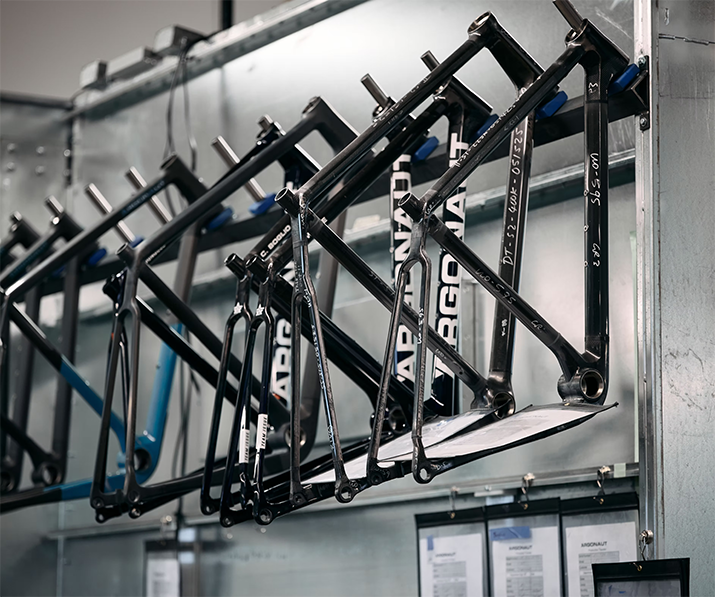
That is a slow way to build a bike company. It is also the only way to end up where they are now, with the design, the engineering, the layup, the molding, the alignment, the paint and the final assembly all happening in the same building. Their own FAQ says the entire process "happens under one roof in Bend, Oregon."
Farver is blunt about why he will not send the work out.
"Outsourcing would mean being responsible for the outcome but not the process. For the bike but not the build. That is not a trade we can make."
And somewhere behind that, the version he does not dress up:
"We don't outsource manufacturing because I'm personally responsible for whether someone gets hurt."
You can go see it, too. The shop is open Monday through Friday, 9 to 5, and they will give you a tour.
The silicone trick
Most carbon frames are made by wrapping fabric around an inflatable bladder, dropping it in a mold and pumping it up. It works. It is also why production frames have wrinkles, voids and resin pools in places nobody ever sees.
Argonaut uses a patented process they call High Pressure Silicone Molding, or HPSM. Instead of a bladder, they lay carbon over precision machined silicone mandrels, rigid ones, so the pressure during the cure is uniform everywhere instead of wherever the balloon happened to push hardest. Their engineering page sums up the payoff: "Cleaner Fiber. The finished part matches the design intention. Every time."
Then it gets obsessive. Every frame is built one piece at a time, a head tube here, a seat cluster there, and those sections get bonded into sub-assemblies with alignment checked by tooling that measures "within fractions of a millimeter."
Farver's read on why nobody else bothers: "Most carbon bikes are built the same way they were built 20 years ago. The aerospace and F1 industries moved on. We followed them."
Not the stiffest bike, on purpose
The marketing arms race in cycling has been stuck on two numbers for a decade, watts saved and bottom bracket stiffness, and Argonaut thinks both are the wrong target.
"The industry has been racing toward aerodynamics and stiffness for a decade. Neither one is the most important thing about a bicycle."
What they chase instead is dynamic response, the frame doing different things in different directions at the same time. Torsionally stiff, vertically compliant, horizontally rigid, all in one tube set. Carbon can do that. Steel and titanium cannot, not really.
The catch is you have to design it for a specific human being. So they do. "Every layup is designed around a specific rider. Weight. Power. Style." Fit happens either in Bend on a Guru dynamic fit machine or through an authorized fitter, and from there you land in one of 13 proven sizes or get geometry drawn from scratch.
There is a line on the founder's wall worth stealing: "I spent years making things beautiful. Racing taught me that beautiful things that break are worthless."
The bikes
The RM3 is the road bike, and Argonaut calls it "our classic 911. Resolved. Timeless. Holding a line dead stable at 50 miles an hour." Most builds land around 15 pounds. Framesets start at $8,500, complete bikes at $17,000, and the standard finish is high gloss automotive grade so you can actually see the weave.
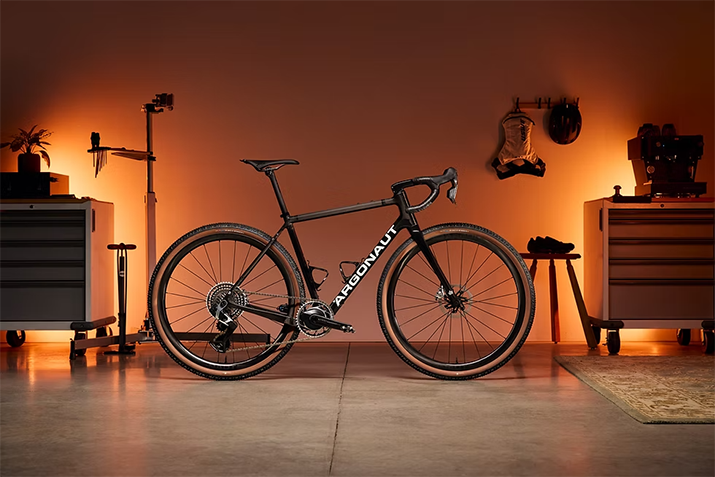
The GR3 is the gravel bike: slacker head angle, clearance for 50mm tires, and a rear center shorter than a lot of road bikes. It wears a Cerakote ceramic matte finish because gravel does what gravel does. Around 16 pounds, framesets from $6,500, complete bikes from $15,000. Cycling Weekly's Anne-Marije Rook rode one and reported it "feathery light, snaps like a whip and begs to go fast."
Then there is Supernaut, a hyper limited series of one or two bikes a year built around an idea rather than a customer. "A layup we've never attempted. A collaboration that demands its own expression." Rare, singular, never repeated.
What it takes, and what you get
Every bike takes at least 40 labor hours across all departments. A deposit of $1,000 holds your slot. An RM3 or GR3 runs 8 to 12 weeks, full custom with new tooling runs 12 to 16. You work with a project manager, plus Ben on geometry, Cory on the build kit, and John and Paul on paint.
The coverage is what you would expect from a shop that has to look you in the eye: 10 years on the frame, 5 years on the paint, lifetime on their R43 and D33 rims, and a 30 day ride guarantee that refunds the frameset if it does not click. Because they build everything themselves, they can also repair or refinish your bike to original spec years later, which is a thing no overseas production frame will ever offer you.
We have written about American bicycles before, from Guardian Bikes in Indiana to Wyatt Bicycles in Wisconsin and Capitol Bicycles in Kentucky. Argonaut Cycles sits at the far end of that spectrum, where a bicycle stops being a purchase and starts being a commission.
Two hundred a year. Every one of them made by people whose names Ben Farver knows.
Just another great reason to buy American!